
The summer of 2026 has given us another reminder of how quickly extreme heat can affect everyday life. Following a series of heatwaves and record-breaking temperatures, the evidence of their impact is now starting to emerge.
More than 2,700 people are estimated to have died from heat-related causes during the May and June heatwaves in England and Wales, according to research from Imperial College London, the Met Office and the London School of Hygiene & Tropical Medicine.
The pressure was also felt across the NHS. Between June and August, there were more than 7.3 million A&E attendances — around 240,000 more than during the same period in 2025. NHS leaders described 2026 as the NHS’s most challenging summer on record, with extreme heat contributing to increased demand for emergency services.
Heat can also make existing health problems worse. Respiratory conditions, for example, can be affected by a combination of high temperatures, air pollution and longer pollen seasons.
The disruption has not been limited to healthcare. In June, more than 1,000 schools were reported to have closed because of extreme temperatures, disrupting education at a time of year when we would normally expect children to be approaching the end of the school year.
There is another part of the story that is easy to overlook. Heat is not experienced equally and where we live matters.
Our recent article highlighted some of the factors that make London particularly vulnerable to extreme heat, including its density, the amount of built-up land and the way buildings and hard surfaces absorb and retain heat.
New analysis from Ordnance Survey provides another useful perspective. It identifies the City of London and City of Westminster as among Britain’s most heat-retentive urban environments. The City of London has the highest built-environment vulnerability and the least effective natural cooling of the cities included in the analysis.
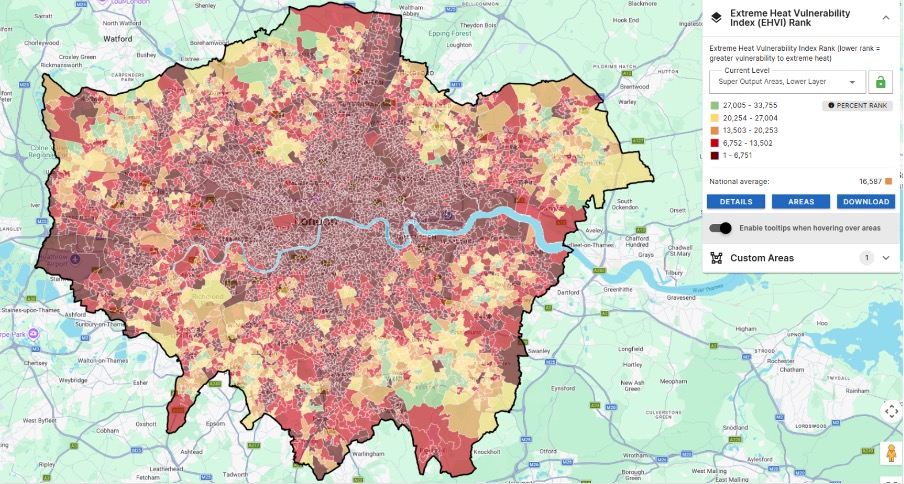
But the picture becomes even more striking when we look at vulnerability. Using research from Friends of the Earth, OCSI found that 18 of the 20 local authorities with the highest average levels of extreme heat vulnerability in England are London boroughs, with most concentrated in inner London. Newham has the highest vulnerability in England in terms of its ability to respond to heat, followed by Brent and Tower Hamlets.
However, borough-level averages can hide what is happening at a much more local level. When we look at neighbourhoods rather than whole boroughs, the differences become clearer. Inner London has the greatest number of neighbourhoods with the highest levels of extreme heat vulnerability, with Finsbury Park West in Islington borough identified as the most vulnerable neighbourhood in England.
A city can have an overall heat risk, and a borough can have an average level of vulnerability, but neither tells us exactly what someone experiences on the ground. Heat is ultimately experienced at street and neighbourhood level.
Compare this with Milton Keynes. It has the most effective natural cooling in the Ordnance Survey analysis, with a much greater proportion of natural surfaces relative to made surfaces. Trees, vegetation and water can provide shade and help cool the surrounding environment, while natural surfaces behave differently from buildings, roads and other hard surfaces when they absorb and release heat.
This does not mean that one place is simply “safe” from heat and another is not. Even Milton Keynes is projected to move into a higher level of heat vulnerability as the climate continues to warm. Natural cooling can reduce some of the impact, but it cannot remove the underlying trend.
When we talk about extreme heat, we often talk about the temperature. But perhaps we should also be talking about place.
Two people can experience the same heatwave very differently depending on where they live, work, travel, exercise or spend their time. A tree-lined park is not the same as a heavily built-up town centre. A sports pitch surrounded by trees is not the same as an artificial surface surrounded by concrete.
For sport and physical activity, this matters. The places where people are encouraged to be active are also places that can be exposed to extreme heat. So as our climate changes, we need to think beyond the question of “How hot will it get?”.
We also need to ask: Where will the heat be felt most and which places will retain it? Which facilities will become harder to use for physical activity during periods of extreme heat?
Heat could become a disruptor to how our places, facilities and opportunities for physical activity work. And that is the question I will explore in the next article: “Extreme heat – nature’s silent disruptor.”