
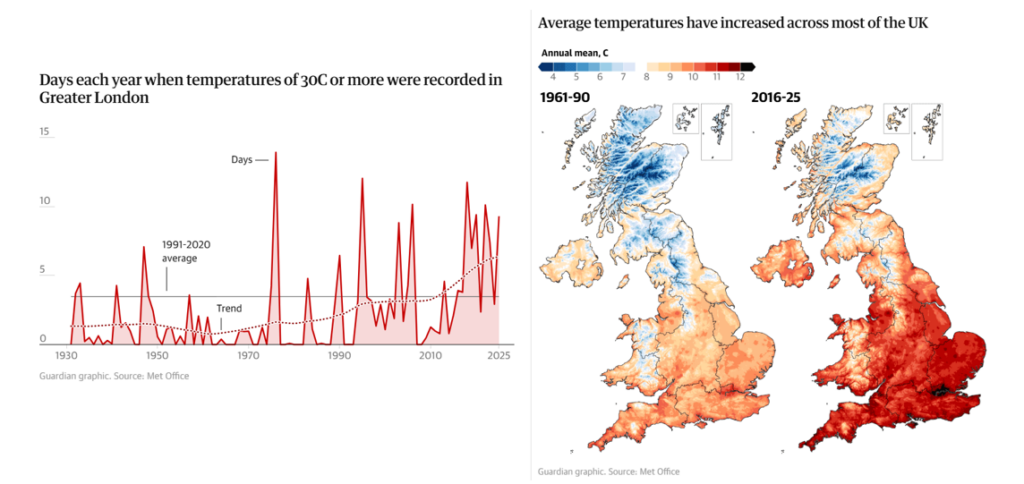
Over the past decade, London has experienced a clear warming trend, with hotter summers becoming increasingly common.
While many of us welcome warm, sunny weather after the winter months, prolonged periods of extreme heat are becoming harder to manage. Staying cool during heatwaves often means relying on fans, cold drinks, ice lollies and finding shade wherever possible.
Several factors are contributing to rising temperatures. The urban heat island effect means cities are warmer than surrounding rural areas because buildings, roads and other hard surfaces absorb and retain heat. Heat domes can make matters worse by trapping warm air over cities for prolonged periods.
Trees, parks and green spaces help cool the city by providing shade and releasing moisture into the air. However, as natural landscapes are replaced by buildings and paved surfaces, London loses some of its natural cooling capacity. Bricks, concrete and tarmac absorb and store heat throughout the day, releasing it slowly into the evening and intensifying the effects of heatwaves.
As the climate changes, many homes and public services are struggling to cope. A recent analysis by the Greater London Authority estimates that around one million homes are at high risk of overheating, alongside more than 1,300 schools, 60 hospitals and 351 care homes located in areas at high risk of extreme heat.
The consequences are not felt equally. Rising temperatures increase the risk of climate injustice, with the greatest impacts falling on those least able to adapt. The UK Government Actuary’s Department found that every neighbourhood ranked among both the 10% most deprived in England and the 10% most exposed to hot summer days is located within London boroughs, including Brent, Haringey, Hackney, Tower Hamlets and Newham.
Those most at risk include people living in deprived communities, disabled people, older adults and people with long-term health conditions. High housing costs, poorly insulated homes, limited access to cooling measures such as air conditioning, and fewer opportunities to retrofit homes all increase vulnerability to extreme heat.
As London continues to warm, creating a more climate-resilient city will require greater investment in green infrastructure, climate-responsive building design and sustainable transport, while reducing reliance on private cars. Adapting our neighbourhoods today will help ensure London remains a healthy, safe and active city in the decades ahead.