
There are many ways we can help London adapt to future extreme heat. But adaptation cannot simply mean responding when the next heatwave arrives.
We need to start thinking about where heat is likely to be greatest, who is most exposed, and how the places around us can help people stay active safely. One place to start is with urban heat maps.
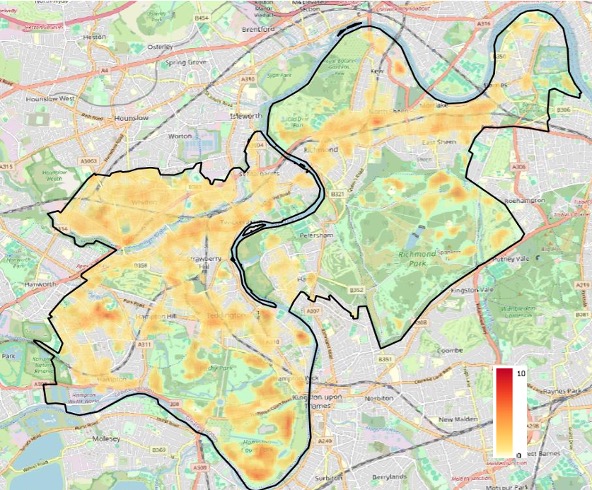
They can help us see something that is difficult to understand from temperature data alone: heat is not experienced equally across a city. Take the London Borough of Richmond. The Urban Heat Index map shows a clear contrast between areas with more vegetation and areas dominated by hard surfaces. The greener areas are generally cooler, while areas with greater concentrations of buildings and hard surfaces retain more heat.
The physical characteristics of a place can influence how hot it becomes. Trees and vegetation can provide shade and help cool the surrounding environment. Water can also play an important role.
But we also need to think about the future. It is not enough to plant trees. We need to think about whether the trees we plant today will be able to thrive in the climate we are moving towards. If we get this wrong, we could lose some of the natural cooling that people will increasingly depend on.
The Hammersmith and Fulham Urban Heat Index map provides another useful illustration. The map shows cooler areas around the River Thames and areas of vegetation, with some locations recording surface temperatures substantially below the surrounding urban environment.
In extreme heat, the difference between a shaded and exposed environment can become much more significant. This is why local intelligence matters.
If heat does not affect every neighbourhood equally, then our response should not be the same everywhere. Local authorities have an important role in identifying areas where heat exposure, deprivation, limited green space and other forms of vulnerability overlap.
For the sport and physical activity sector, this creates an opportunity to work more closely with local government and heat maps could help inform that decision. They could also help us identify existing facilities that may be particularly exposed to extreme heat and therefore require adaptation.
And for new facilities, heat resilience could become part of the design brief from the beginning. This is where Active Design becomes increasingly important.
But there is another opportunity that deserves more attention. Could sport facilities themselves become part of London’s heat resilience infrastructure? I recently discussed this with David Gent, CEO of Active Humber, and Andy Coley-Maud, Sport England’s Head of Environmental Sustainability.
David described how West Hull amateur rugby league club, located in a deprived area of Hull, operates as a warm hub during winter. People can use the club as a warm, welcoming place when heating their own homes is difficult, while also having access to food and social contact.
The conversation provoked us to think about the other side of the equation.
If some sport facilities can provide warmth during winter, could adapted facilities also provide cool refuge during extreme heat? The idea is worth exploring.
Facilities with suitable cooling, shade, water and comfortable indoor environments could potentially provide places for people to escape extreme heat, particularly in neighbourhoods with limited access to green or naturally cool spaces.
This would change how we think about the role of a community sports facility. It would not simply be a place people visit for a particular activity. It could become part of the wider social infrastructure of a neighbourhood.
There could also be a secondary benefit. Someone might initially visit because they need somewhere cool. They might then become familiar with the building, the people who run it and the activities available. A conversation at reception could become an introduction to a new activity. A visit during a heatwave could become a regular visit throughout the year.
This should not be assumed to happen automatically, but it raises an interesting possibility: could climate adaptation also become an engagement opportunity for sport?
There is another part of the system that we need to consider: the people delivering activity.
The sport workforce is fundamental to keeping communities active, yet we have much more to learn about how extreme heat will affect coaches, instructors, volunteers and other outdoor workers.
There has been growing discussion about workplace heat thresholds and protections for workers. But how does this translate to an outdoor coaching session?
At what temperature should a session be changed, shortened or cancelled? Does the answer change depending on humidity, sunlight, age, intensity of activity or the health needs of participants? What should a coach do when conditions become unsafe? And who makes that decision?
These questions point towards a need for clearer decision-making frameworks for the sport workforce. Adaptation is therefore not only about buildings and infrastructure. It is also about people, processes and decisions.
We already have a growing range of policies and initiatives that can help. The Mayor of London and the GLA have developed work covering areas including air quality, heat resilience, cooling, waterways and wider climate resilience. Nationally, organisations including Sport England and the British Association for Sustainability in Sport are also supporting the sport sector to respond to climate change.
The foundations are there, but the challenge is connecting them. Air quality cannot be considered separately from heat, and heat cannot be considered separately from green space, and so forth.
This is why extreme heat requires a more joined-up approach. We need local government, planners, health organisations, communities, the sport sector and others to look at the same problem from different perspectives.
A heat-resilient city is not simply one that keeps its buildings cool. It is one that gives people the opportunity to live, move and exercise safely and comfortably as the climate changes.