
Preparing sport for the future
The cost of doing nothing
Building on our previous articles about heatwaves, hot surfaces, changing seasons, flooding and air quality, new research suggests that climate change is becoming a growing concern for the public, including its potential impact on their ability to spend time outdoors over the next ten years.
Persuasion UK’s nationally representative survey of 3,000 adults and London Sport’s Opinium survey of 2,000 UK adults highlight the importance of understanding how climate change could affect everyday life.
Persuasion UK’s research also suggests that people are increasingly concerned that the cost of doing nothing about climate change could outweigh the cost of taking action. This concern is reflected in the Mayor of London’s Heat Ready London report, which highlights that climate-related damage could cost London £36 billion a year by the 2050s. The 2022 heatwave alone was estimated to have cost London £1.5 billion.
Without effective adaptation, these costs could continue to rise, threatening Londoners’ ability to stay safe, healthy and productive.
Why past approaches may no longer work
Research by Dr Holly Collison-Randall and Dr Ksenija Kuzmina highlights the challenges of preparing for an increasingly uncertain future, particularly when it comes to flooding. Their research on living with water explores how communities respond when familiar patterns of flooding become less predictable.
Historically, communities have prepared for seasonal flooding by planning ahead, organising resources and establishing defences. In Fiji, for example, villages have worked together to plan responses, assign responsibilities, gather resources, collaborate with organisations and build protective measures.
However, when flooding becomes less predictable, these preparations become harder to rely on. Events may occur with little warning, leaving communities with limited time to respond. Changes in the timing and intensity of flooding also make it harder to learn from previous experiences and use resources effectively.
This presents a wider challenge for climate change adaptation. Approaches that worked well in the past may no longer be enough to prepare us for what lies ahead.
Climate adaptation must work for everyone
Climate change adaptation is not simply a technical challenge. It also raises questions about fairness: whose needs are prioritised, who has access to protection and who risks being left behind?
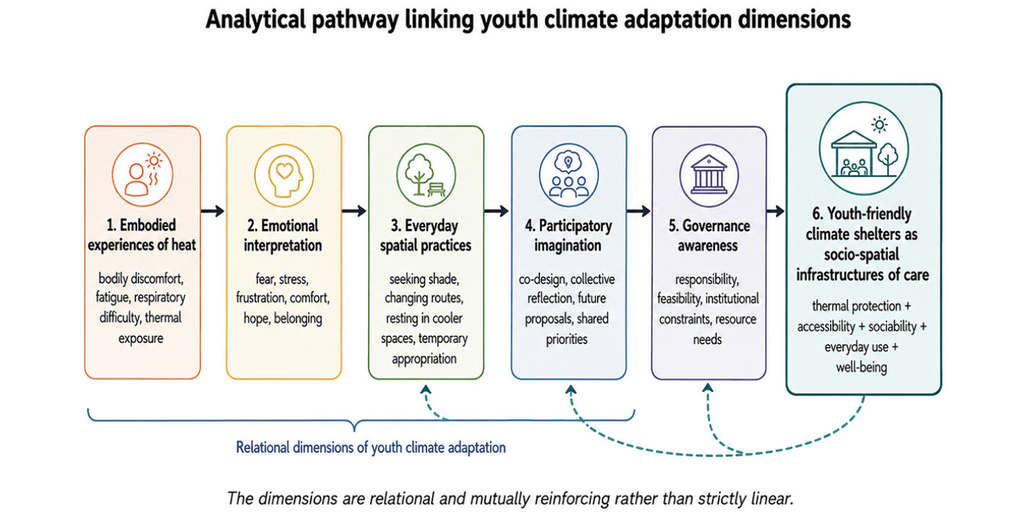
Research on climate adaptation and youth-friendly climate shelters in Brazil highlights the importance of understanding how climate change affects everyday practices and social relationships. This matters when considering how people access and use places to stay active.
For example, travelling to a sports venue by public transport can already be challenging for some Londoners. As extreme heat and other climate-related pressures increase, these journeys could become even more difficult, particularly for older people, women and communities experiencing disadvantage.
Consider an older person living in a home that becomes uncomfortably hot during a heatwave. Older people can be more vulnerable to heat-related illness because the body becomes less effective at regulating temperature as it ages. Travelling to a cooler place may involve additional costs or reliance on public transport, which can itself become uncomfortable or disrupted during extreme heat.
If getting out becomes too difficult, that person may stay at home, miss opportunities to be physically active and become more socially isolated. Over time, this could affect their health and increase pressure on health services.
This illustrates why adaptation must extend beyond making buildings and sports facilities more resilient. It must also consider the entire journey people take to be active, from leaving home to reaching a venue and participating safely.
Building the ability to adapt
To protect opportunities for physical activity and support public health, the sport sector needs to rethink how it prepares for an uncertain climate.
Rather than assuming that what worked in the past will continue to work, we need approaches that can evolve as conditions change. This means considering different possible futures, learning from experience and regularly reviewing what works.
The research on living with water offers a useful principle: we need to continually question, reflect on, adapt and rework our approaches. Instead of relying on a single plan, organisations and communities need the flexibility to respond as new challenges emerge.
This also means looking beyond the physical effects of climate change to understand how they affect people’s everyday lives. Research into making schools youth-friendly climate shelters in Brazil provides an example of how adaptation can be shaped around the needs and experiences of the people who use a place.
For grassroots sport in London, this could mean working with local communities to understand the barriers they face during extreme heat or flooding, and designing solutions around their experiences. These might include identifying cooler and safer routes to sports facilities, adapting activity times or finding suitable alternative spaces when existing venues become difficult to use.
Local knowledge is essential. People who live, work and spend time in an area understand how its spaces are used, where problems arise and what could help. Involving them in decisions can help develop solutions that are relevant to their needs and can change as circumstances evolve.
Putting communities at the heart of adaptation
Grassroots sport has an opportunity to take a more collaborative approach to climate adaptation. Sports organisations could work with local communities, local authorities and climate experts, using information such as urban heat and flood-risk maps, Active Design principles, alongside people’s everyday experiences.
Through place-based approaches and ongoing co-design, communities could help identify risks, test solutions and refine them as conditions change. This would allow grassroots sport to learn and adapt over time, rather than relying solely on top-down plans.
Preparing for an uncertain climate is not about predicting exactly what will happen. It is about developing the knowledge, relationships and flexibility to respond effectively when circumstances change.
For London’s sport sector, the challenge is therefore not just to protect sports facilities from climate change, but to protect people’s ability to be active. That means putting communities at the heart of adaptation and ensuring that future solutions reflect the realities of everyday life.