
The third report in Trajectory and Pragmatix Advisory’s series on Britain’s fertility crisis looks at what happens when living standards stall for a long time. It argues that the UK needs a new social contract, but that the pessimism stagnation creates makes one harder to agree.
In London, the effects of falling birth rates are already showing up in schools, as a recent Schools Week investigation shows:
- Only 2-in-5 UK adults expect a better standard of living than their parents had. GenZ and Millennials are more likely than older generations to see success as down to luck rather than hard work. On a scale of 1-to-10, they scored 5.2 and 5.3, compared with 4.4 for Baby Boomers and 3.8 for the Silent Generation.
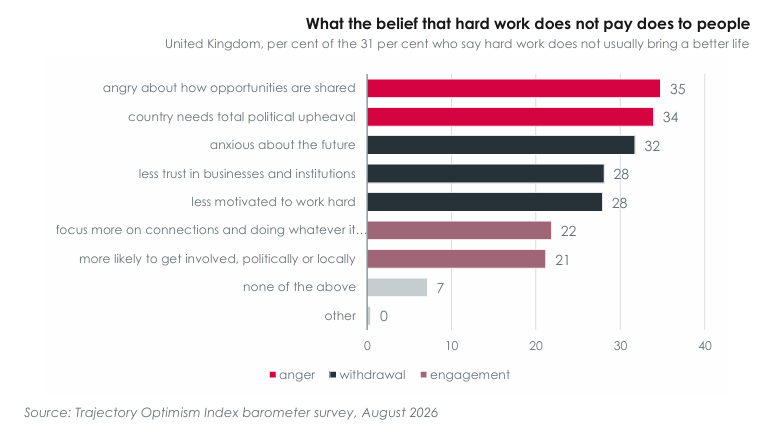
- People tend to respond to long periods of stagnation in one of three ways: anger, getting involved, or giving up. All three are showing up in the UK. Among people who feel hard work doesn’t pay off, 41% of Baby Boomers and the Silent Generation think the country needs a total political upheaval, compared with 28% of GenZ and Millennials. GenZ and Millennials in this group are far more likely to say it makes them want to get involved politically or locally (34% against 9%).
- Other countries show what withdrawal can look like. In China, youth unemployment hit 21% in 2023 and buying a home is out of reach for many young people. This has given rise to “tang ping”, or lying flat, where young people opt out of career progression and life milestones like marriage.
- London is already feeling the effects. The capital’s birth rate fell 17% between 2012 and 2021, a loss of 23,225 children, and seventeen state primaries closed in central London in the past year. Some schools are making up lost income by opening their doors to the community. Ark Evelyn Grace in Lambeth, less than half full, rents out much of its building to community and sports groups.
Links: Britain’s Fertility Crisis | Part 3: The Social Contract | Trajectory and Falling rolls: The true cost of declining school populations