
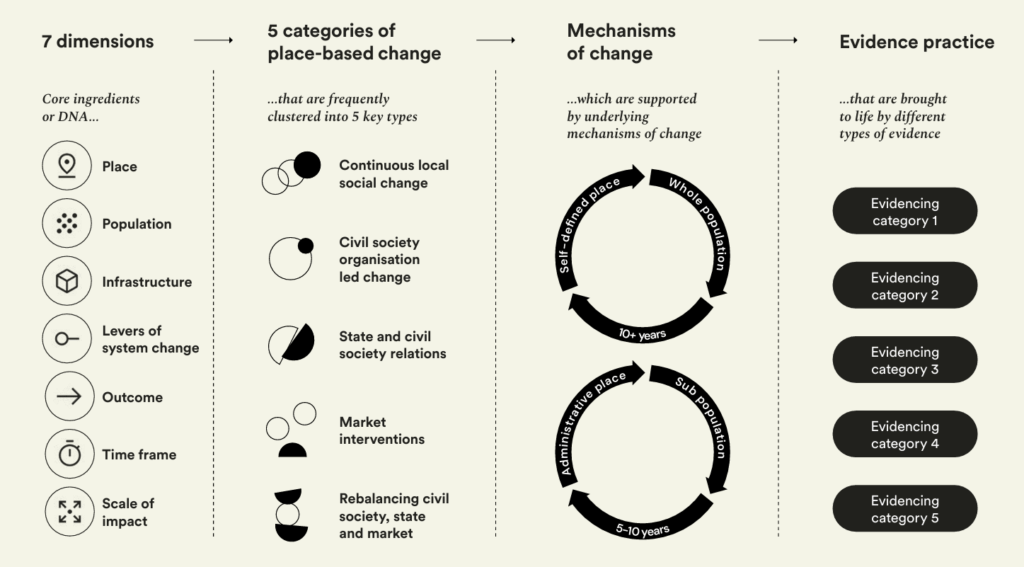
A new report from Place & Evidence emphasises the need for better evidence to understand how to improve places in the UK, noting that progress is challenging due to a centralised government, reduced local funding, and difficulties in long-term collaboration.
It identifies five categories of place-based change:
- Continuous local social change
- Civil society-led change
- State and civil society relations
- Market interventions
- Rebalancing civil society, state and market
The report explains in detail how evidence is collected to assess impact. Community-led work is mainly in categories 1–3, state-led in 3–5, and philanthropic-led in 5.
Place-based change is defined as people working together in a specific area to improve life for everyone there, a process that can take many years.
Projects that do not focus on a place, benefit local people, use local relationships, or allow time for change are not considered truly place-based, and the report recommends learning from each type of work and international examples, especially in categories 4 and 5.